
In tropical climates like India and SE Asia, liquid-cooled EV chargers aren’t optional — they’re the only technology that reliably delivers advertised charging speeds in 45°C+ heat. Air-cooled chargers lose up to 70% of their rated power under extreme thermal stress, while liquid-cooled systems maintain full output. For any deployment where uptime and throughput matter, liquid cooling is the minimum viable technology.
Introduction
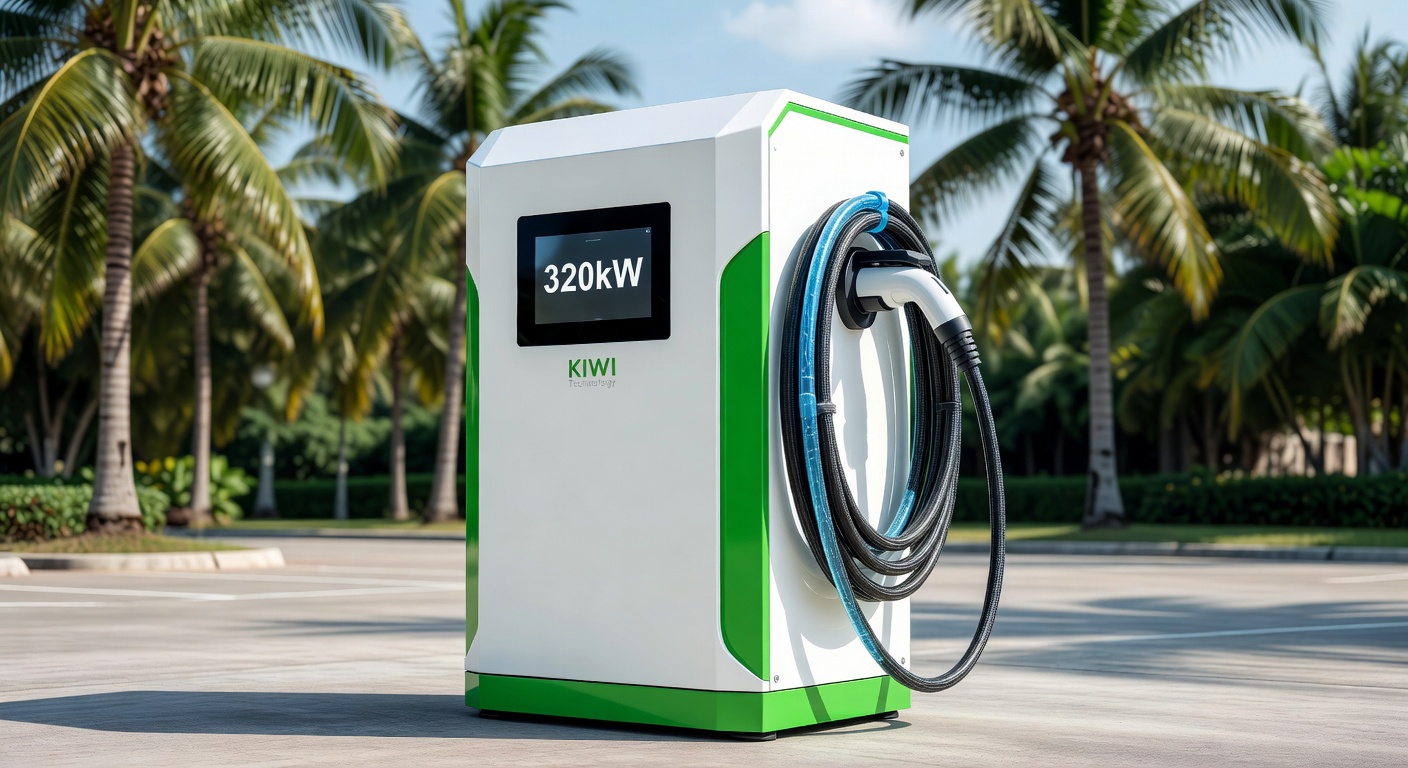
When Shenzhen Kiwi Technology Co., Ltd. evaluates an EV charging deployment in Mumbai, Jakarta, or Bangkok, the first question isn’t about power output or connector types. It’s about cooling.
The cooling strategy of an EV charger determines whether it actually delivers its rated power — or silently throttles to a fraction of its capability the moment the mercury rises. For tropical markets, where ambient temperatures routinely exceed 40°C and can spike to 48°C during summer peaks, this distinction isn’t academic. It’s the difference between a profitable charging station and an expensive paperweight.
In this guide, we break down the two dominant cooling approaches — liquid-cooled and air-cooled — with real-world data, cost analysis, and deployment recommendations for India and SE Asia. Whether you’re a charging network operator, a fleet manager, or a prospective Kiwi partner evaluating your options, this comparison will help you make the right infrastructure decision.
Related reading: Liquid-Cooled EV Charger India: Why Cooling Strategy Is the 2026 Battleground | Benefits of DC Fast Charging | EV Charging Solutions
What Is a Liquid-Cooled EV Charger?
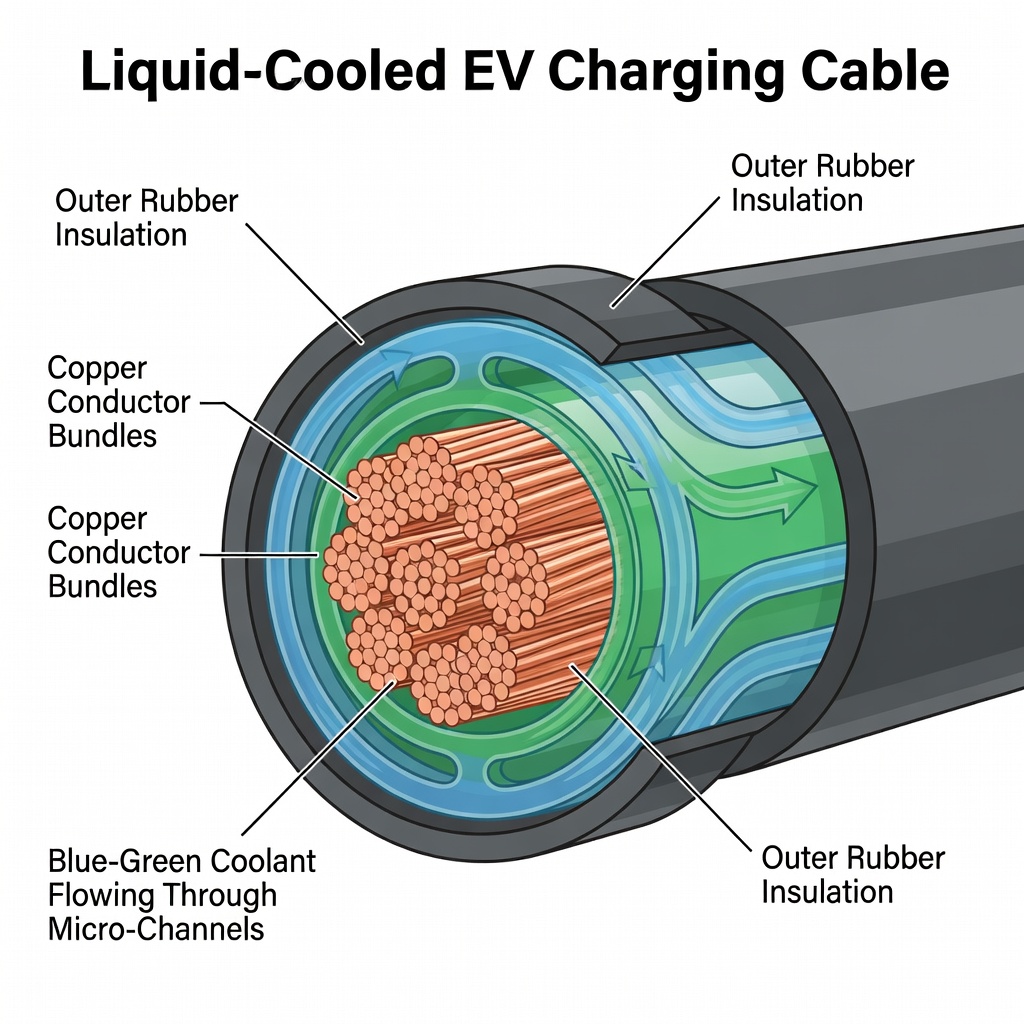
A liquid-cooled EV charger uses a closed-loop coolant system to absorb and dissipate heat generated during high-power charging. Coolant circulates through channels in the charging cable, connector (gun), and sometimes the power electronics cabinet itself, carrying heat away from critical components to a radiator or heat exchanger.
How It Works
- Heat generation: When high current (up to 500A) flows through the charging cable and connector, resistive heating occurs (P = I²R)
- Coolant circulation: A pump pushes dielectric (non-conductive) coolant through channels embedded in the cable and gun
- Heat exchange: The heated coolant flows to a radiator where fans dissipate the heat into the ambient air
- Cooled return: The cooled liquid cycles back to absorb more heat
Key Specifications
| Parameter | Typical Value |
|---|---|
| Coolant type | Dielectric fluid (e.g., Arteco LECC) |
| Heat dissipation capacity | Up to 100 W/cm² |
| Cable temperature | Maintained below 50°C at full load |
| Ambient operating range | -30°C to +55°C |
| Pump lifespan | 50,000+ hours |
What Is an Air-Cooled EV Charger?
An air-cooled EV charger relies on fans and heatsinks to dissipate heat into the surrounding air. The power electronics and cables are designed with larger surface areas and finned heatsinks to maximize convective cooling.
How It Works
- Heat generation: Same resistive heating in cables and electronics
- Heatsink absorption: Metal heatsinks attached to hot components absorb heat
- Forced convection: Fans blow air across the heatsinks to carry heat away
- Passive radiation: Some heat radiates from the enclosure surface
Key Specifications
| Parameter | Typical Value |
|---|---|
| Cooling method | Forced air (fans) + passive radiation |
| Heat dissipation capacity | Up to 30 W/cm² |
| Cable temperature | Can exceed 70°C at full load in hot ambient |
| Ambient operating range | -20°C to +40°C (derated above 35°C) |
| Fan lifespan | 30,000-50,000 hours |
Head-to-Head Comparison
Performance in Tropical Climates
This is where the two approaches diverge most dramatically. The comparison below uses real-world data from deployments in India, the Middle East, and Southeast Asia.
| Factor | Liquid-Cooled | Air-Cooled |
|---|---|---|
| Rated power at 30°C ambient | 320kW (100%) | 320kW (100%) |
| Rated power at 40°C ambient | 310kW (97%) | 260kW (81%) |
| Rated power at 45°C ambient | 295kW (92%) | 180kW (56%) |
| Rated power at 50°C ambient | 270kW (84%) | 100kW (31%) |
| Consecutive session performance | No derating for 3+ sessions | 15-20% drop per consecutive session |
| Cable weight | 40-50% lighter (thinner gauge) | Heavier, thicker cables |
| Noise level | 55-65 dB (pump + radiator fan) | 60-75 dB (multiple high-speed fans) |
| Maintenance | Coolant check every 12 months | Fan replacement every 2-3 years |
| Initial cost | 15-25% higher | Lower upfront |
| Total cost of ownership (5 years) | Lower (less downtime, higher throughput) | Higher (throttling losses, maintenance) |
| Reliability in dust/sand | Sealed system, protected | Fans vulnerable to dust ingress |
The 45°C Threshold
The critical inflection point is 45°C ambient temperature. Above this threshold:
- Air-cooled chargers enter a thermal runaway cycle: higher temperatures → reduced cooling efficiency → even higher temperatures → aggressive throttling
- Liquid-cooled chargers maintain linear derating: the coolant system has sufficient headroom to absorb the additional thermal load
For reference, these are peak summer temperatures in Kiwi’s target markets:
| City | Peak Summer Ambient | Days Above 40°C/Year |
|---|---|---|
| Delhi, India | 48°C | 45-60 |
| Mumbai, India | 38°C (but 42°C in direct sun on equipment) | 15-25 |
| Chennai, India | 45°C | 30-40 |
| Jakarta, Indonesia | 36°C (but 43°C on rooftops/parking) | 20-30 |
| Bangkok, Thailand | 40°C | 40-55 |
| Manila, Philippines | 38°C (but 45°C in enclosed parking) | 10-20 |
| Ho Chi Minh City, Vietnam | 37°C (but 42°C on exposed surfaces) | 15-25 |
The takeaway: Even cities with “moderate” ambient temperatures create conditions where air-cooled chargers derate significantly — because equipment in direct sun, enclosed parking, or poorly ventilated areas experiences temperatures 5-8°C higher than the weather report.
Cost Analysis: The Real Numbers
Data sources: Industry benchmarks from IEA Global EV Outlook 2026 and Ministry of Heavy Industries, India.
Upfront Cost Comparison (320kW DC Fast Charger)
| Cost Component | Liquid-Cooled | Air-Cooled |
|---|---|---|
| Charger unit | $42,000 – $48,000 | $35,000 – $40,000 |
| Installation | $3,000 – $5,000 | $3,000 – $5,000 |
| Total upfront | $45,000 – $53,000 | $38,000 – $45,000 |
| Premium | +18% | Baseline |
5-Year Total Cost of Ownership (India Deployment)
| Cost Component | Liquid-Cooled | Air-Cooled |
|---|---|---|
| Upfront cost | $48,000 | $40,000 |
| Energy cost (5 years) | $18,000 | $19,500 (fans consume more in hot climates) |
| Maintenance (5 years) | $2,500 | $4,000 (fan replacements, cleaning) |
| Revenue lost to throttling | $0 | $12,000 – $18,000 |
| Total 5-year cost | $68,500 | $75,500 – $81,500 |
The liquid-cooled charger is cheaper over 5 years despite the higher upfront cost, because it doesn’t lose revenue to thermal throttling. Every hour a charger is throttled to 50% capacity is an hour of lost charging sessions and lost revenue.
Related: EV Charger Rental and Leasing Options
Why Kiwi Chooses Liquid Cooling for Tropical Markets
At Kiwi Technology, we don’t believe in one-size-fits-all cooling. Our approach is climate-matched thermal management:
For Tropical Deployments (India, SE Asia, Middle East, Africa)
We deploy liquid-cooled cable systems because:
- Reliability is non-negotiable. A charging station that throttles unpredictably destroys operator credibility and driver trust
- Revenue depends on throughput. In high-utilization locations (highways, fleet depots), every percentage point of throttling is lost revenue
- Cable ergonomics matter. Liquid-cooled cables are thinner and lighter, making them easier for all users to handle — especially important in markets where drivers may not expect heavy cables
- Future-proofing. As charging power increases to 500kW and beyond, liquid cooling is the only technology that scales
For Temperate Deployments (Northern Europe, Northern China)
We offer air-cooled solutions where the climate supports them, because:
- Lower upfront cost is appropriate when thermal derating is minimal
- Simpler maintenance (no coolant loops) reduces service requirements
- Adequate performance — air cooling works well below 35°C ambient
The Kiwi Advantage
Our chargers feature modular power architecture (60kW to 320kW scalable) with liquid-cooled cable options that can be matched to each deployment’s climate profile. This means partners don’t pay for cooling they don’t need — but they’re never caught without it when the temperature rises.
Explore Kiwi’s DC Fast Charging Range | About Kiwi Technology
Emerging Cooling Technologies
While liquid cooling is the current standard for tropical deployments, several emerging technologies are worth monitoring:
| Technology | Status | Relevance to Tropical Markets |
|---|---|---|
| Phase-change dielectric cooling | Emerging (2026-2028) | Handles 250+ W/cm² — could enable 500kW+ in extreme heat |
| Oil immersion cooling | Early trials | Promising for megawatt-level charging terminals |
| Intelligent thermal management | Early commercial | AI-driven predictive cooling — reduces energy use by 15-20% |
| Cryogenic cooling | R&D only | Not practical for commercial deployment in next 5 years |
Kiwi’s modular architecture is designed to accommodate these technologies as they mature, protecting our partners’ infrastructure investments.
What This Means for Partners
For companies evaluating EV charging partnerships in India and SE Asia, the cooling technology decision directly affects your bottom line. Here’s what to look for:
- Climate-matched specification: Don’t spec a charger based on datasheet numbers alone —insist on tropical-climate performance data. Ask for power output at 45°C ambient, not just 25°C.
- Total cost of ownership: The 15-25% upfront premium for liquid cooling is recovered in 2-3 years through higher throughput and lower maintenance. Over 5 years, liquid cooling saves money.
- Modular architecture: Choose chargers that let you match cooling to the deployment. Kiwi’s modular power architecture (60kW-320kW) with liquid-cooled cable options gives you this flexibility.
- Future-proofing: As charging networks scale to 500kW+, liquid cooling is the only cable technology that scales. Air-cooled chargers will need replacement.
Learn more about Kiwi’s partner program →
Frequently Asked Questions
What is the main difference between liquid-cooled and air-cooled EV chargers?
The main difference is how each system removes heat from the charging cable and power electronics. Liquid-cooled chargers use circulating coolant to absorb and transport heat, while air-cooled chargers rely on fans and heatsinks. In tropical climates, liquid cooling maintains full power output where air cooling can lose 50-70% of rated capacity.
Are liquid-cooled EV chargers more expensive?
Yes, liquid-cooled chargers cost 15-25% more upfront than air-cooled equivalents. However, the total cost of ownership over 5 years is typically lower for liquid-cooled systems in tropical climates because they don’t lose revenue to thermal throttling and require less maintenance.
Can air-cooled chargers work in India?
Air-cooled chargers can operate in India, but with significant limitations. In northern and central India where summer temperatures exceed 45°C, air-cooled 320kW chargers may deliver only 150-200kW during peak heat. They’re more suitable for hill stations, coastal areas with sea breezes, or lower-power applications (60-120kW).
How long do liquid-cooled EV chargers last?
Liquid-cooled charging systems are designed for 10+ years of commercial operation. The coolant is sealed and requires checking only annually. Pumps are rated for 50,000+ hours (approximately 8-10 years of continuous operation). Kiwi’s chargers come with comprehensive warranty coverage.
What happens if a liquid-cooled system leaks?
Modern liquid-cooled chargers use dielectric (non-conductive) coolant that is safe even in the event of a leak. Kiwi’s systems include leak detection sensors that automatically reduce power output and alert operators before any safety issue arises. The coolant volume is small (typically 2-5 liters) and environmentally safe.
Which connector types do liquid-cooled chargers support?
Liquid-cooled cables support all major DC fast charging connectors: CCS1, CCS2, NACS (Tesla), and CHAdeMO. The cooling technology is independent of the connector standard. Kiwi’s chargers support CCS1 + NACS dual connectors as standard for the Indian market.
Is liquid cooling necessary for 150kW chargers?
For 150kW chargers in tropical climates, liquid cooling is recommended but not strictly necessary. At 150kW, the current is lower (typically 300-375A), which generates less resistive heat. Enterprise-grade air cooling can handle 150kW at up to 40°C ambient. However, liquid cooling provides additional headroom for consecutive sessions and future power upgrades.
Data and context sourced from:
- Electrek
- Charged EVs
- ScienceDirect
- IEA Global EV Outlook
- PatSnap
- ABB EV Charging
- SK Signet
- Hanon Systems
- BYD
- Arteco
- Fraunhofer IZM
- CNEV Post
Conclusion
The choice between liquid-cooled and air-cooled EV chargers isn’t about technology snobbery — it’s about matching the cooling solution to the climate. For tropical markets like India, Indonesia, Thailand, and the Philippines, liquid cooling isn’t a premium feature. It’s the baseline requirement for reliable, revenue-generating charging infrastructure.
Kiwi Technology’s approach is simple: deploy the cooling that each market demands. Our modular chargers let partners start with the right thermal configuration from day one, with upgrade paths as their networks grow.
Ready to deploy climate-ready charging infrastructure? Contact Kiwi Technology to discuss your project requirements.