
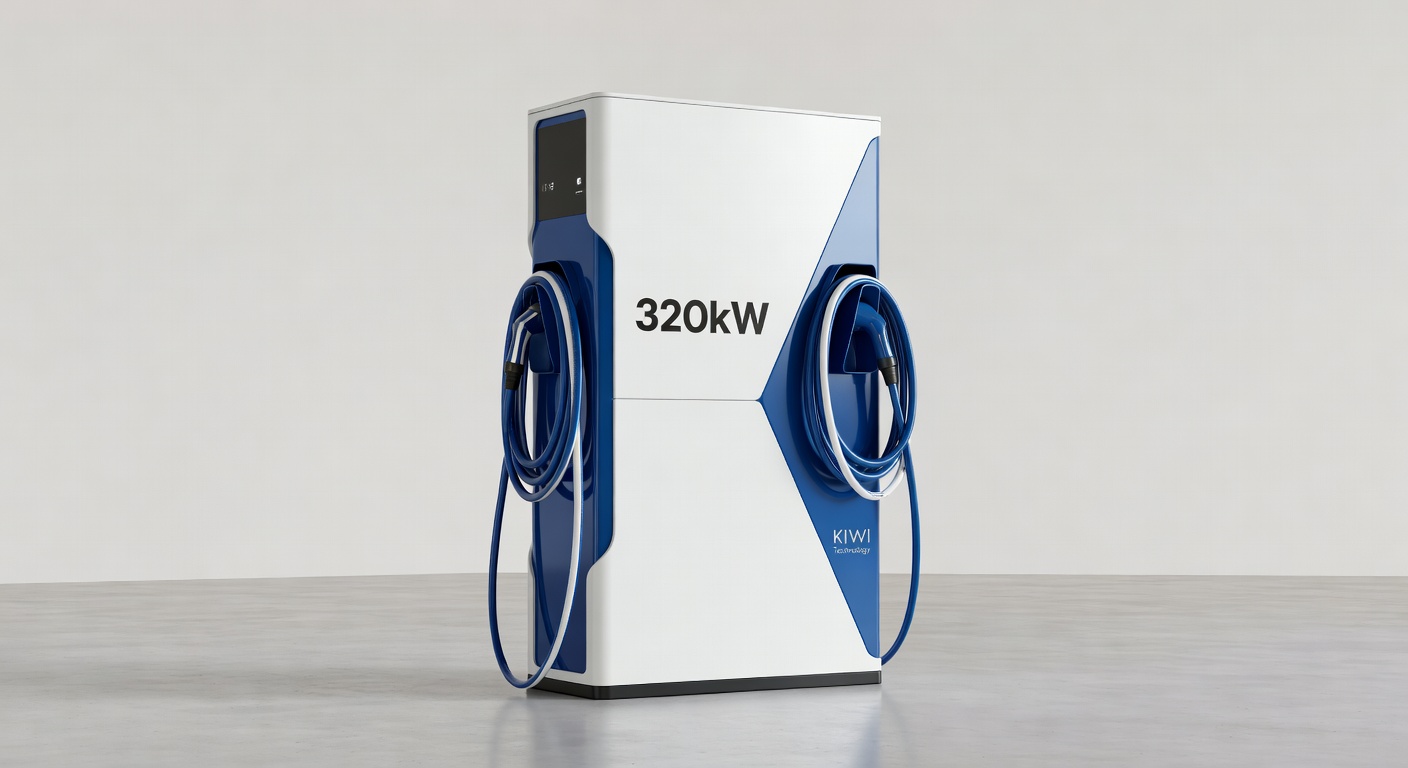
The EV charging industry reached a critical inflection point in 2026. With 320kW becoming the new standard for DC fast charging and BYD deploying megawatt flash charging at scale in China, the conversation has shifted from “how do we get to 350kW” to “how do we deploy reliable high-power charging in the world’s most demanding climates.”
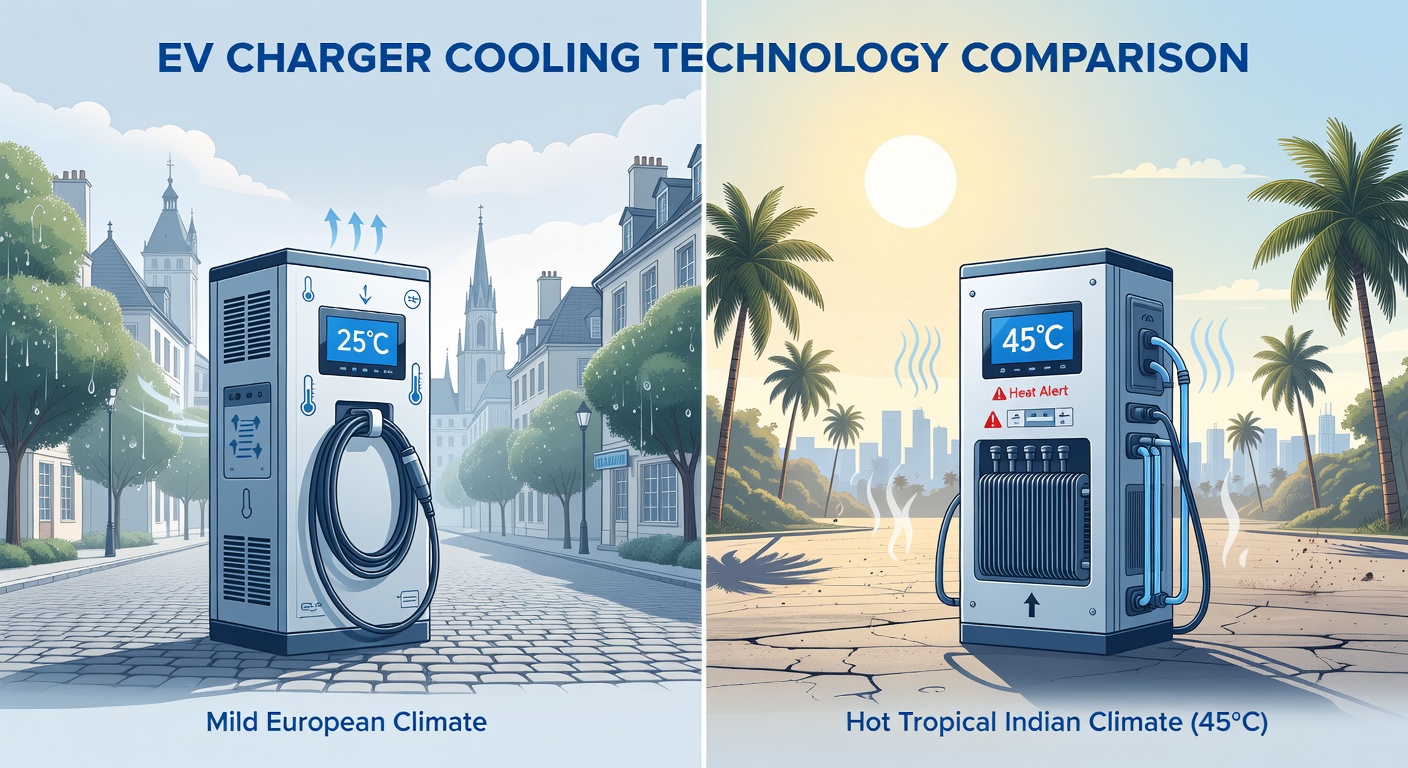
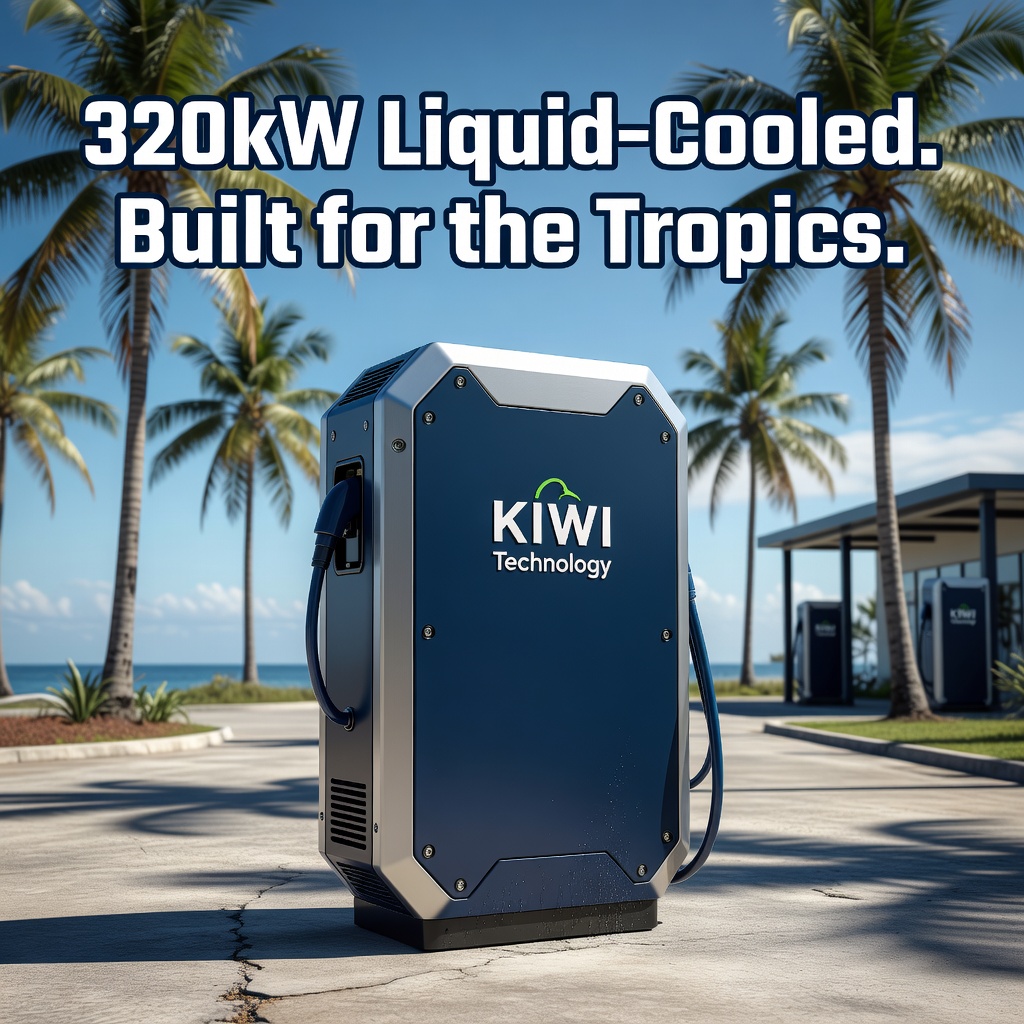
For India and SE Asia — Kiwi Technology’s primary target markets — this shift presents a unique challenge. When ambient temperatures hit 45°C+ during Indian summers, a liquid-cooled EV charger India isn’t a luxury — it’s a necessity for sustained charging throughput. The cooling strategy you choose determines whether your 320kW charger actually delivers 320kW or throttles to 100kW after ten minutes.
The 2026 Landscape: Three Approaches, Diverging Strategies
Two major charger launches in Q1-Q2 2026 signal that 320kW is becoming the new benchmark. But the cooling approaches couldn’t be more different:
1. Charge Rigs OMEGA V2 — Air Cooling (April 2026)
The OMEGA V2 takes a pragmatic approach: enterprise-grade side-flow air cooling with no liquid cooling loops to maintain. Modular from 60kW to 320kW, it delivers 200–1000V DC at 0–500A with >95% efficiency. Dual CCS1 + NACS connectors and OCPP 1.6J/2.0.1 compliance make it a flexible choice. But in India’s 45°C+ heat, air cooling at 320kW faces real thermal limits.
2. SK Signet All-in-One — Liquid-Cooled Cables (March 2026)
SK Signet takes the opposite approach with SiC (Silicon Carbide) modules achieving 96.5% efficiency and liquid-cooled cables supporting CCS1/NACS. The 54% smaller footprint makes it deployment-friendly. Most critically for India: liquid-cooled cables enable sustained high-current output in hot environments.
3. BYD Megawatt Flash Charging — Fully Liquid-Cooled (February 2026)
BYD’s megawatt deployment changes expectations for the entire industry. At up to 1,000 kW (1 MW) per terminal with fully liquid-cooled cables and guns (surface temps <50°C), it sets a new performance floor. The 400 km in 5 minutes capability uses 10C charge rates with Blade Battery 2.0. While not directly relevant to Kiwi’s current deployment, it raises partner expectations — 320kW is now the entry point.
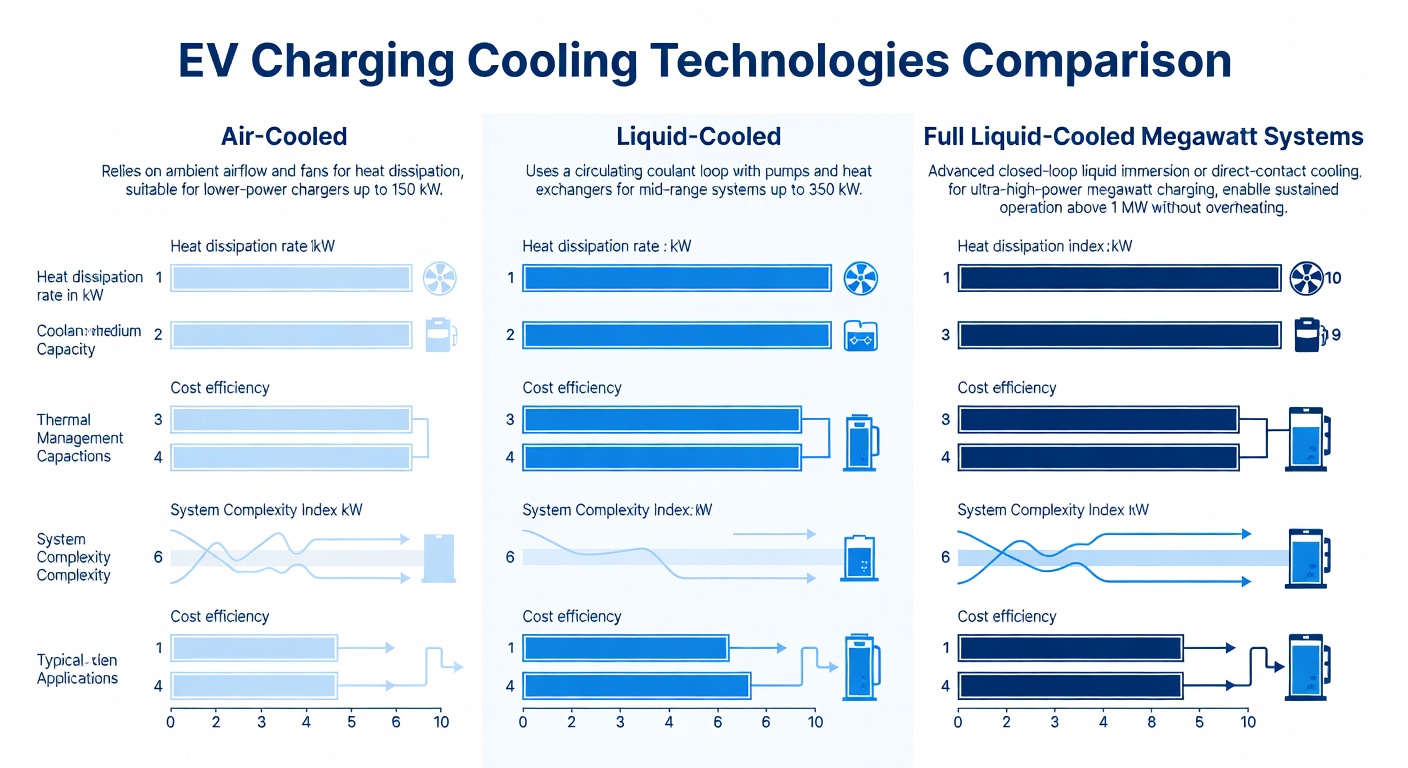
Cooling Strategy Divergence: Three Approaches
The industry is diverging further rather than converging on a single cooling approach. For Kiwi’s liquid-cooled EV charger India market deployment, air cooling at 320kW may struggle — favoring liquid-cooled cables for sustained throughput. This is why Kiwi emphasizes thermal readiness over cost optimization.
| Charger | Cooling Approach | Why It Matters |
|---|---|---|
| OMEGA V2 | Side-flow air cooling (enterprise-grade) | Lower maintenance, no coolant loops, simpler deployment |
| SK Signet | Liquid-cooled cables | Sustained high-current output, smaller cable gauge |
| Tesla V4 Supercharger | Liquid-cooled cable + cabinet | Proven reliability at 350kW sustained |
| BYD Flash Charger | Fully liquid-cooled (cable + gun + terminal) | Required for 1,000A+ — air cooling cannot scale to megawatt levels |
Thermal Throttling: The Real-World Enemy
Real-world data from EV forums reveals what happens when cooling fails in Indian conditions. Electrify America 350kW stations throttle to 30-100kW when liquid cooling loops fail — the single most-cited complaint. For India, where temperatures exceed 45°C, these effects are magnified. Consecutive DCFC sessions compound the problem: back-to-back fast charges cause progressive throttling without sufficient cooling time.
Why 800V Architecture Is the Thermal Solution
The Hyundai IONIQ 9 provides the most concrete data: charging 10-80% takes 24 minutes at a native 800V station vs. 40 minutes at 400V. The voltage conversion itself generates additional thermal overhead. This validates Kiwi’s strategy: native 800V charging avoids the 30%+ thermal efficiency penalty of 400V→800V boost conversion, delivering the fastest, coolest charging.
The Supplier Ecosystem Is Maturing
Several developments validate liquid cooling for India. KühlTherm launched a dedicated liquid cooling provider for India/GCC extreme heat targeting 150-350kW. Arteco LECC coolants enable safer liquid-cooled cable deployment. ABB OM X-Series confirms end-to-end liquid cooled megawatt charging. Fraunhofer IZM demonstrated 99% SiC inverters — less waste heat means less throttling. This convergence reduces deployment risk for Kiwi’s liquid-cooled EV charger India strategy.
Kiwi’s Positioning: Modular, Liquid-Cooled, Climate-Ready
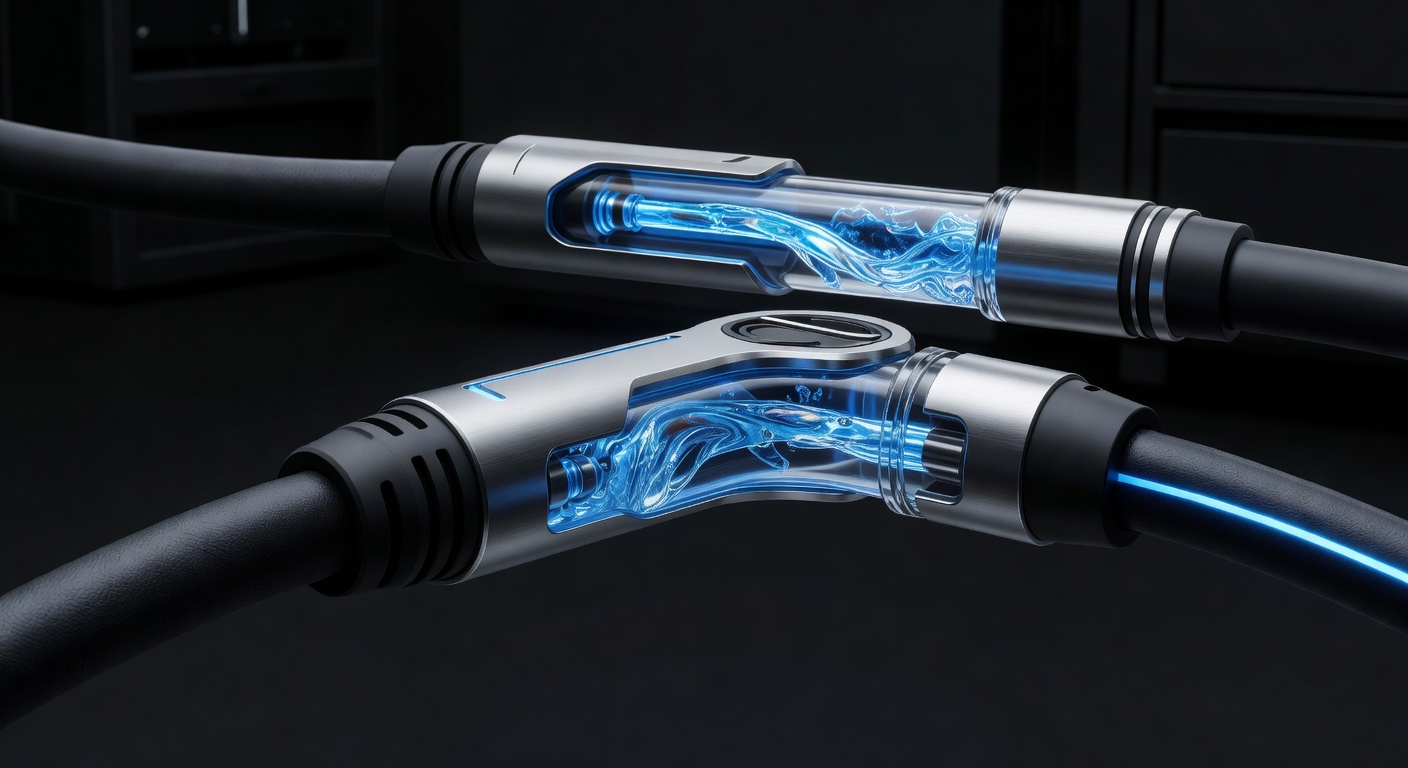
The industry is bifurcating between air-cooled 320kW (mild climates) and fully liquid-cooled megawatt. Kiwi occupies the sweet spot: liquid-cooled 320-500kW chargers with modular upgrade paths for India and SE Asia. Learn more about EV charging solutions and DC fast charging technology.
What This Means for Partners
- Diverging cooling strategies need deployment-context decisions — air cooling suits moderate climates; liquid-cooled cables essential for Indian summers.
- Modular architecture enables phased rollout — start at lower power, scale as density increases.
- BYD megawatt deployment raises expectations — 320kW is the floor. Plan 500kW+ readiness.
- OCPP 2.0.1 compliance ensures interoperability across India and SE Asia networks.
Frequently Asked Questions
What is a liquid-cooled EV charger and why does India need one?
A liquid-cooled EV charger uses circulating coolant to dissipate heat enabling sustained high-power output. In India’s 45°C+ climate, air-cooled chargers can lose 50-70% power due to throttling — liquid cooling maintains full output even in extreme heat.
Is air cooling sufficient for 320kW charging?
In moderate climates (<35°C), enterprise-grade air cooling works. But in tropical markets where ambient temperatures exceed 45°C, liquid-cooled cables become essential. The thermal margin of air cooling disappears above 40°C ambient.
How does 800V charging reduce thermal stress?
800V architecture achieves the same power at half the current (320kW at 400A vs 800A). Lower current means less resistive heat (P = I²R). The Hyundai IONIQ 9 demonstrates this: 24 min 10-80% at 800V vs 40 min at 400V — a 40% speed advantage.
What happens when a liquid-cooled charger’s cooling fails?
Electrify America data shows cooling failures cause chargers to throttle from 350kW to 30-100kW — a 70-90% drop. Kiwi emphasizes redundant cooling and proactive monitoring with fast-response sensors like the Posifa PGS5100 (100ms thermal event detection).
How does Kiwi Technology’s strategy address India’s extreme heat?
Kiwi combines liquid-cooled cables for sustained high-current output, modular 60-320kW architecture for phased deployment, and 800V-native compatibility to minimize thermal losses. We prioritize cooling that matches each deployment’s climate profile.
Is megawatt charging coming to India soon?
BYD’s megawatt is deploying at scale in China with Europe expansion underway. For India, megawatt charging is likely 2-3 years away. In the meantime, 320-500kW liquid-cooled chargers represent the practical sweet spot for highways and urban depots.
Conclusion
In 2026, cooling strategy has become the defining differentiator for EV charging infrastructure. For India and SE Asia, the answer is clear: liquid-cooled cables are the minimum viable technology for reliable 320kW+ charging in tropical climates.
Kiwi Technology deploys the cooling that each market demands, with modular upgrade paths to scale. The liquid-cooled EV charger India market is about keeping the entire charging experience reliable, fast, and scalable — even at 45°C in the shade. Explore our charging infrastructure guide and network overview.
Real-World Data: What the Forums Say About Cooling Failures
Forum scan across Reddit EV communities (May 2026) reveals 11 critical findings that directly inform Kiwi’s cooling strategy. The most important insight: every modern EV except the Nissan Leaf uses liquid-cooled battery packs. Without it, thermal throttling cuts charge speed by 50%+ within 10 minutes.
Charger-side cooling failures cascade hard. Electrify America 350kW stations are notorious for throttling to 30-100kW when liquid cooling loops fail. Rivian owners are especially vocal about this issue, documenting repeated sessions where advertised 350kW speeds dropped to under 100kW due to overheating. The implication for India is clear: if cooling failure is disruptive in moderate climates, it becomes catastrophic in 45°C+ heat.
Battery preconditioning makes the difference. Tesla owners report 30% speed drop when battery is below 30°C. The optimal charging temperature is 42°C+. In India’s climate, preconditioning becomes less critical for achieving target temperatures, but the risk shifts to overheating without adequate charger-side cooling.
Low-voltage architectures run hotter. The Chevy Equinox EV (Ultium platform) peaks at 150kW but throttles hard at 350-500A because high amps at low voltage generate excess heat even with liquid cooling. This is a fundamental 400V vs 800V architectural problem that directly supports Kiwi’s 800V-native charger strategy.
Emerging Technologies in Charger Thermal Management
The PatSnap IP analysis (April 30, 2026) maps 60+ patent records across four thermal architecture clusters. Liquid loops remain the mature, dominant approach. Phase-change dielectric cooling handles 250+ W/cm² heat fluxes and is positioned as the next frontier beyond liquid. Cryogenic systems remain in early R&D. Intelligent/adaptive thermal management uses algorithm-driven control.
Oil immersion cooling is emerging for megawatt chargers. EV engineering outlets report liquid-immersion and oil-cooled systems entering trials for 1MW+ terminals, promising 25%+ better heat dissipation than conventional liquid-cooled cables.
The Hanon HICE module (deployed in BMW iX3) unifies thermal management, treating battery, cabin, and drivetrain as a single thermal system. For Kiwi’s charger infrastructure planning, future EVs will have more sophisticated onboard thermal capacity to handle sustained 320kW+ charging, reducing the burden on charger-side cooling alone.
| Technology | Heat Flux Handling | Maturity | Kiwi Relevance |
|---|---|---|---|
| Liquid loops | Up to 100 W/cm² | Mature, dominant today | Current deployment standard |
| Phase-change dielectric | 250+ W/cm² | Emerging | Next horizon when >500kW is standard |
| Cryogenic systems | Extreme | Early R&D | Long-term monitoring only |
| Intelligent/adaptive | Algorithm-driven | Early commercial | Complementary software layer |
Market Implications for Kiwi’s India and SE Asia Deployment
Two developments in May 2026 sharpen Kiwi’s positioning. First, KühlTherm entered as a dedicated liquid cooling provider for India and GCC extreme heat — a new purpose-built liquid-cooled charging system targeting 150-350kW, explicitly designed for 45°C+ ambient temperatures. This validates the thesis that air cooling at 320kW is inadequate for Kiwi’s target markets.
Second, BijliWaliGaadi — India’s leading EV insights portal — published a comprehensive thermal management guide framing cooling as “the new horsepower” for Indian conditions. This is exactly the message Kiwi should amplify: in 45°C heat, cooling strategy IS the competitive advantage. The Indian EV market is projected to grow at 44% CAGR through 2030, and charging infrastructure must keep pace with both volume and thermal demands.
The PatSnap IP analysis confirms that thermal management is the binding constraint for high-power charging. Four competing cooling architecture clusters exist: liquid loops (mature, dominant today), phase-change dielectric (emerging for 250+ W/cm² heat fluxes), cryogenic (early R&D), and intelligent/adaptive systems (algorithm-driven). For Kiwi’s charger hardware, this validates liquid cooling as the present standard and positions phase-change and immersion cooling as the technology horizon when >500kW becomes standard in target markets.
Hyundai IONIQ 9 data proves that 800V-native charging is 40% faster than 400V. Electrek’s comprehensive review (May 14, 2026) confirms that native 800V charging completes 10-80% in 24 minutes vs 40 minutes at a 400V station. The thermal overhead of boost-converting 400V to 800V is a real, measurable penalty. This creates a clear marketing angle for Kiwi: native 800V chargers deliver faster charging and less heat stress than 400V infrastructure.
BYD’s megawatt deployment continues to reshape expectations, but the immediate competitive threat and opportunity is at 320-500kW with the right cooling. Kiwi’s message remains: we deploy the cooling your climate demands — not a one-size-fits-all megawatt gantry that costs 10x and targets only flagship highways. The modular approach with liquid-cooled cables wins in dense urban India and SE Asia where high-amp draw in 40°C+ heat is the daily reality.
As charging speeds increase to 320kW+, battery thermal event risk grows proportionally. The Posifa PGS5100 MEMS-based hydrogen sensor offers 100ms response time and 15-year service life for early-warning thermal event detection. Deploying these sensors alongside liquid-cooled chargers creates a complete thermal safety stack for high-amp charging in hot climates. For Kiwi’s partners, this means not just faster charging but safer charging — a critical selling point in markets where electrical fire safety is a top concern.
Comparative Analysis: Air Cooling vs. Liquid Cooling at 320kW
The decision between air and liquid cooling for 320kW chargers is not a technology arms race — it is a deployment-context decision. Understanding the trade-offs helps Kiwi’s partners make the right choice for their specific market conditions.
Air Cooling Advantages: Lower upfront cost, simpler maintenance with no coolant loops to manage or replace, and proven reliability in moderate climates. The OMEGA V2 demonstrates that enterprise-grade side-flow air cooling can deliver 320kW reliably when ambient temperatures stay below 35°C. No coolant monitoring, no pump maintenance, no leak risk. For depots in cooler regions or indoor installations, air cooling is the pragmatic choice.
Air Cooling Limitations: Above 40°C ambient, thermal margin disappears rapidly. In Indian summers reaching 45-50°C, air-cooled chargers must either throttle output or accept reduced component lifespan. Heat dissipation scales with temperature difference (ΔT) — when ambient air is already hot, air cooling loses effectiveness exponentially.
Liquid Cooling Advantages: Sustained high-current output regardless of ambient temperature. SK Signet and Tesla V4 demonstrate that liquid-cooled cables maintain full rated power at 45°C+. Smaller cable gauge reduces handling weight. The ABB OM X-Series shows that even megawatt-class charging relies on end-to-end liquid cooling. For Kiwi’s target markets, liquid cooling is the only option that guarantees advertised charge speeds year-round.
Liquid Cooling Considerations: Higher upfront cost, regular coolant maintenance cycles, and the need for leak detection systems. However, the Arteco LECC coolant launch (April 2026) with <100 μS/cm conductivity significantly reduces electrical safety risks in liquid-cooled cable systems.
| Factor | Air Cooling | Liquid Cooling |
|---|---|---|
| Upfront cost | Lower | Higher (15-25% premium) |
| Maintenance complexity | Low (no coolant loops) | Moderate (coolant monitoring & replacement) |
| Performance at 45°C+ ambient | Throttles to 50-70% | Full rated output sustained |
| Cable handling weight | Heavier gauge required | Lighter, more ergonomic |
| Best climate fit | <35°C, indoor depots | >35°C, tropical, high-amp |
| Megawatt scalability | Not feasible | Proven path to 1MW+ |
Recommended Next Steps for Kiwi’s Channel Partners
For partners evaluating liquid-cooled EV charger deployment in India and SE Asia, Kiwi recommends a phased approach. Phase 1 (months 1-3): deploy 150kW liquid-cooled chargers at high-traffic urban locations to establish reliability and gather thermal performance data. Phase 2 (months 4-8): upgrade to 320kW units at highway corridors where sustained high-power charging is essential. Phase 3 (months 9-12): integrate 500kW-ready infrastructure at flagship locations, with OCPP 2.0.1 interoperability across all tiers.
Each phase should include comprehensive thermal monitoring using fast-response sensors and remote diagnostic capabilities. The supplier ecosystem for liquid-cooled charging is maturing rapidly — purpose-built coolants, dedicated India-focused cooling providers, and sub-second thermal event sensors are all commercially available. This reduces both the cost and risk of deploying liquid-cooled infrastructure in tropical markets. Contact Kiwi Technology to discuss your deployment requirements.
Key References and Sources
- Charge Rigs OMEGA V2 — Official Launch Details (April 2026)
- SK Signet All-in-One 320kW/400kW Charger (March 2026)
- BYD Super e-Platform & Megawatt Flash Charging — Official Site
- CNEVPost — BYD Megawatt Flash Charging: 400 km in 5 Minutes
- MotorTrend — BYD Megawatt Flash Charging System Analysis
- Electrek — Hyundai IONIQ 9 2026 Review: 800V Charging Analysis (May 14, 2026)
- Reddit r/electricvehicles — Community Charging Discussions
- Reddit r/Rivian — EA Station Derating Reports
- Reddit r/Ioniq5 — Charging Speed & Thermal Data
- ChargedEVs — Liquid-Cooled Charging System Coverage (May 2026)
- PatSnap — EV Power Electronics Cooling IP Analysis (April 30, 2026)
- ScienceDirect — Liquid Cooling Parasitic Load Research
- ABB OM X-Series — Megawatt Charging System (May 2026)
- Fraunhofer IZM — 99% SiC Inverter Demonstration (May 2026)
- Hanon Systems — HICE Unified Thermal Management Module
- Arteco — LECC Coolants for EV Charging Infrastructure (April 2026)